
Operational flows and stages
Important: this content is part of the Introduction to the activities module.
The concepts presented here are specific to the context of using the Blue Service platform.
Operational flow and stages are fundamental elements of a process.
An operational flow is a continuous path through which activities flow.
It is composed of stages, which are points along the flow that constitute pre-defined states or situations, where certain actions or decisions must be made.
Defining the stages of a flow
During the planning or design of a process, it is necessary to define all the stages of its operational flow. They must represent all the key situations or moments that an activity goes through during its execution. The number of stages should be defined according to the process needs, and each stage must have a name that identifies that point in the flow. In addition to the name, on the platform stages can be identified by colors and numbers.
See some examples of operational flows and stages:

In a recruitment and selection process (HR), for example, the operational flow could contain the following stages:
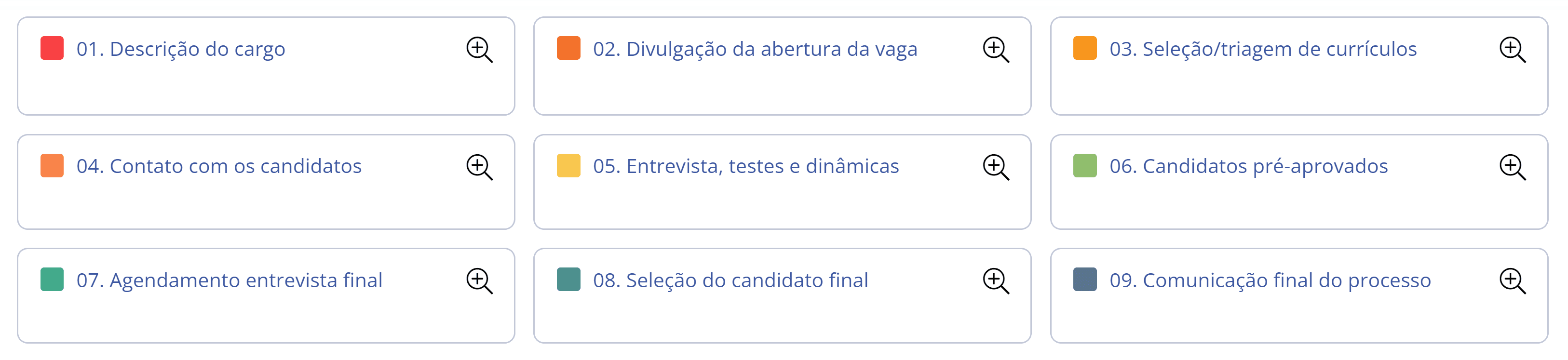

In an expense reimbursement process (finance), the operational flow could contain the following stages:

Non-linear flows
The sequence of stages within the flow must also be defined according to the process needs. It is important to consider that operational flows are not linear. In other words, activities will not always follow all stages sequentially in a single path.
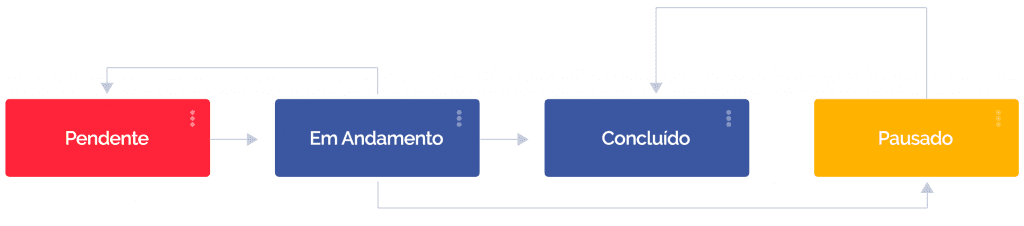
There are processes in which the activity may move backward in the flow, returning to some previous stage. Another flow break situation occurs when an activity skips a certain stage in the flow. This is very common in approval processes, for example, where one activity may proceed to a non-approval stage, while another activity may proceed to the approval stage. These movements are inherent to each type of process and are supported by the platform through the stage transition rules.
Stage transition rules
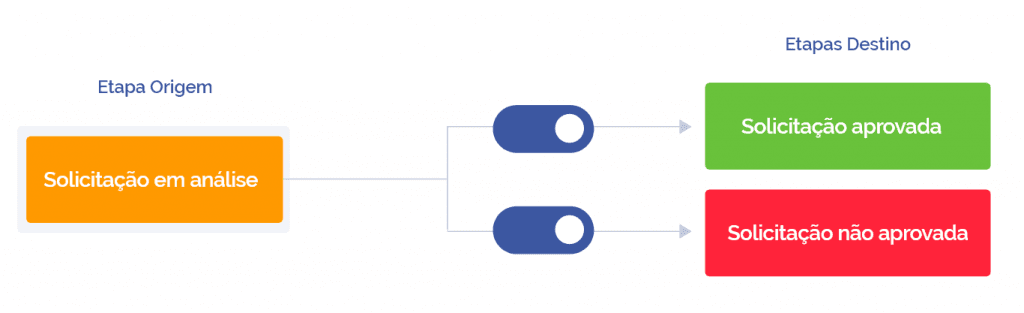
After defining all the stages of a flow, it is necessary to establish origin and destination rules, which are the transitions or movements between stages. For example: a stage called “Request under review” may have the stages “Request approved” or “Request not approved” as destinations. These destination possibilities need to be enabled in each stage. This ensures the smooth flow of activities throughout the flow.
Thus, with the flow defined and the stage transition rules configured, it is time to go into the process details, creating forms, fields, triggers, among other elements. In the next topic, we will see the differences between activity types and activities.