Accessing a specific legal document allows a complete view of the content, as well as the ability to insert and change information according to your user permission. Let's get to know it:
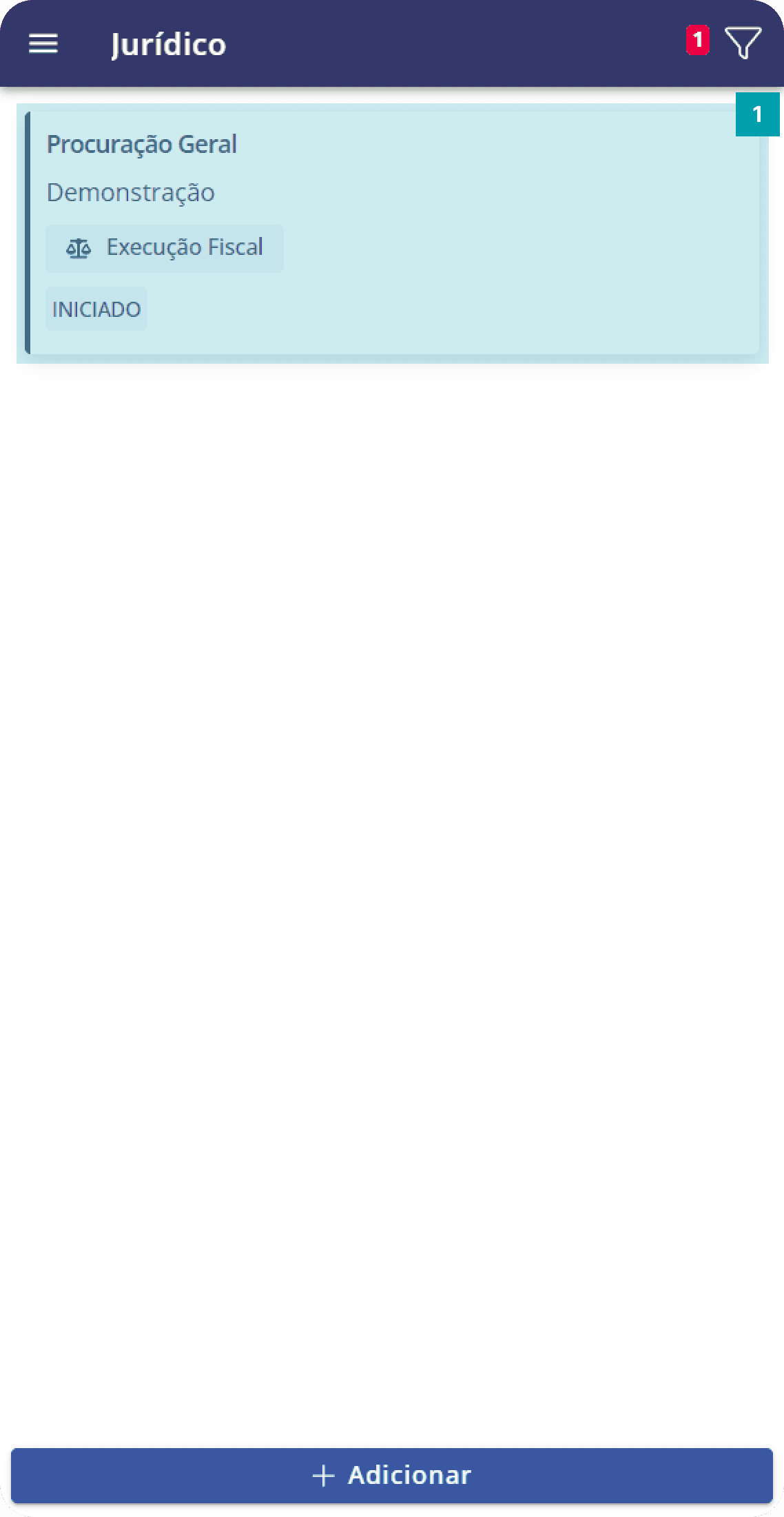
To open a legal document, just click the card of the desired document in the list.
Details panel
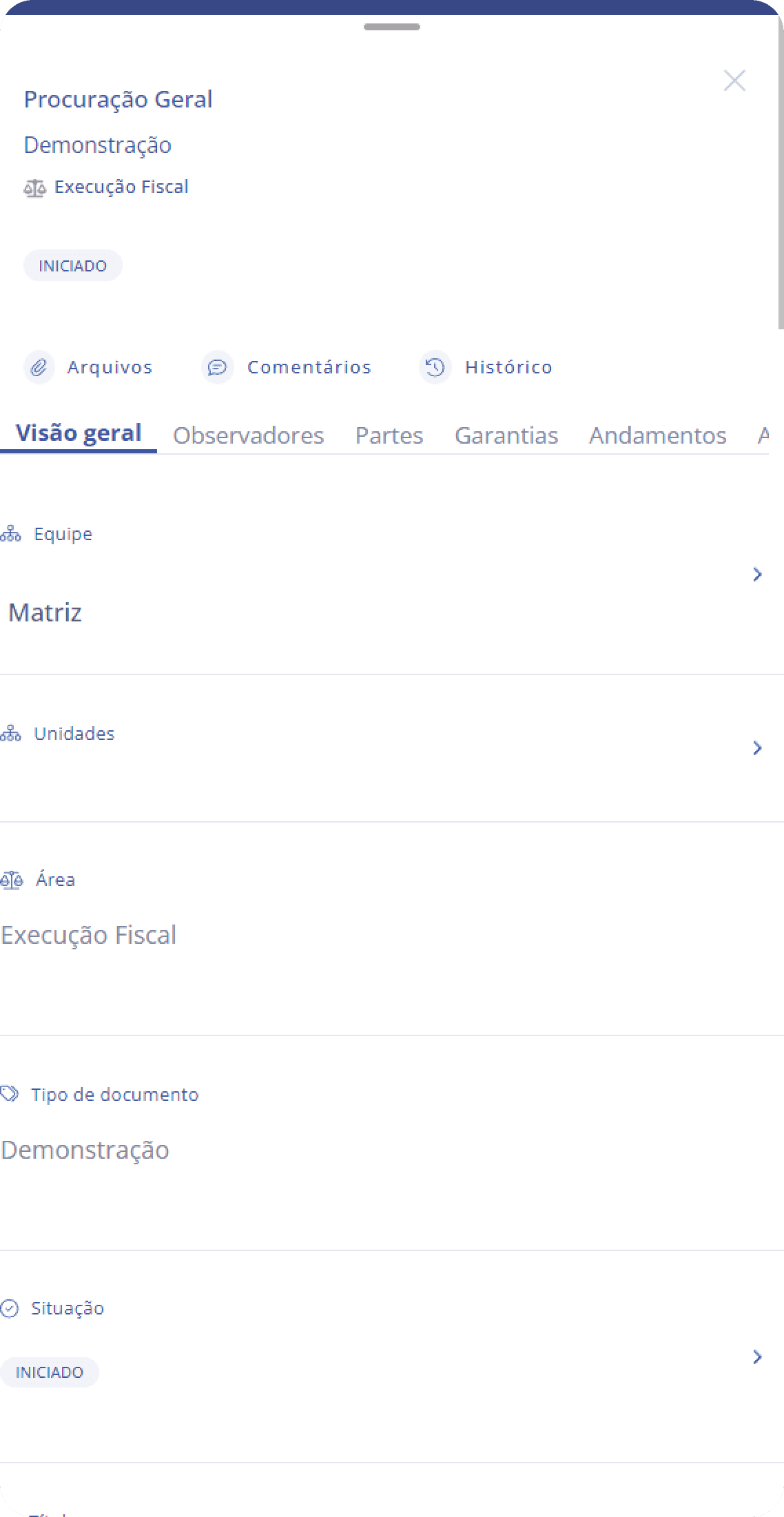
The first panel of a legal document is called Overview. This panel has two sections, namely the fixed and dynamic fields section, that is, the same fields will be present in all legal documents.
Fixed fields section
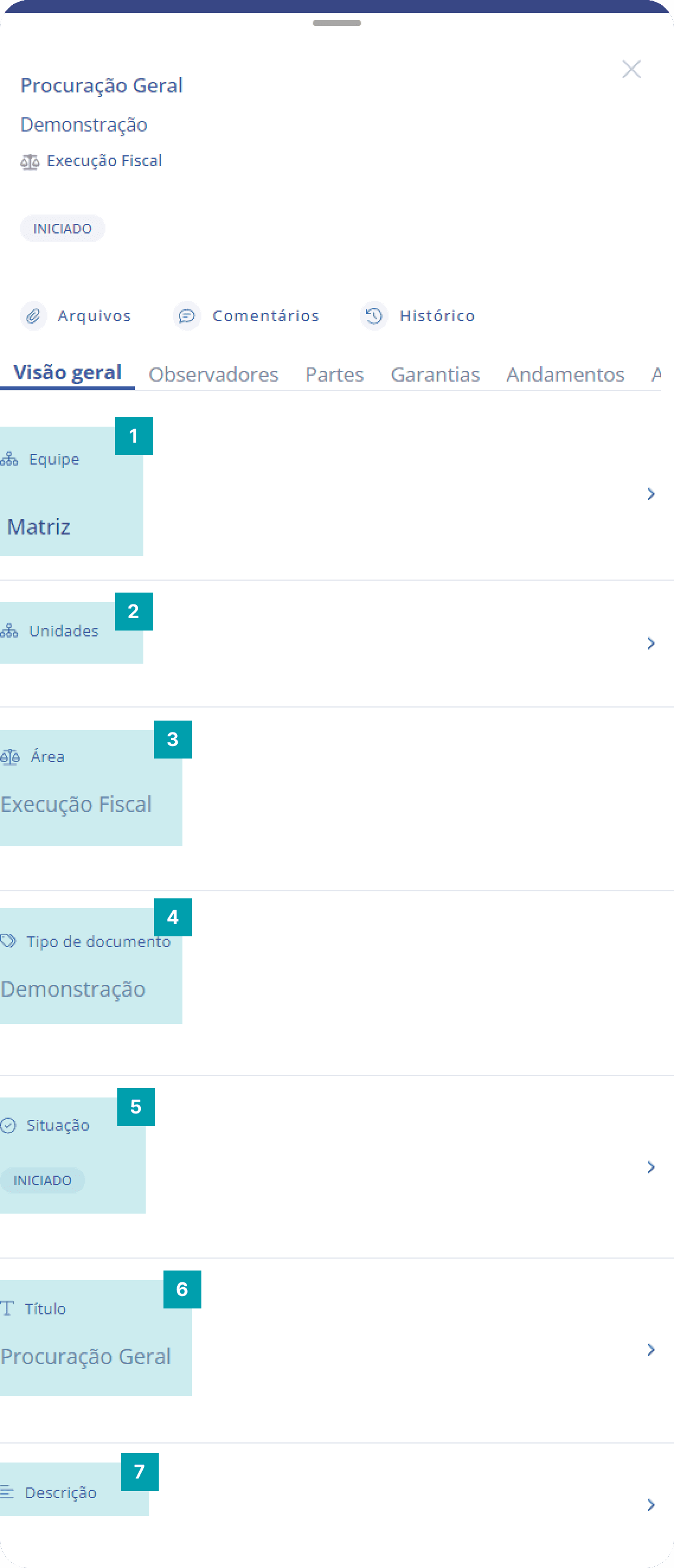
Team – Shows the team(s) that the legal document belongs to.
Units – Shows the unit(s) associated with the legal document.
Area – Shows the area that the legal document belongs to.
Document type – Shows the type of document that the legal document belongs to.
Status – Shows the status of the legal document.
Title – Shows the identification title of the legal document.
Description – Shows the description of the legal document.
Important: The information contained in the listing and in the overview of a unit is displayed according to the access permissions you have as a Blue Service platform user.
Dynamic fields section
Unlike fixed fields, dynamic fields are basically alternative fields that can be configured and associated with a certain document type through the web platform. In this way it is possible to customize fields for your form, so the form information becomes specific and allows accurate management, focusing on capturing essential information for managing the legal document. The dynamic fields section is located just below the fixed fields section and has several types of fields; let's get to know them:
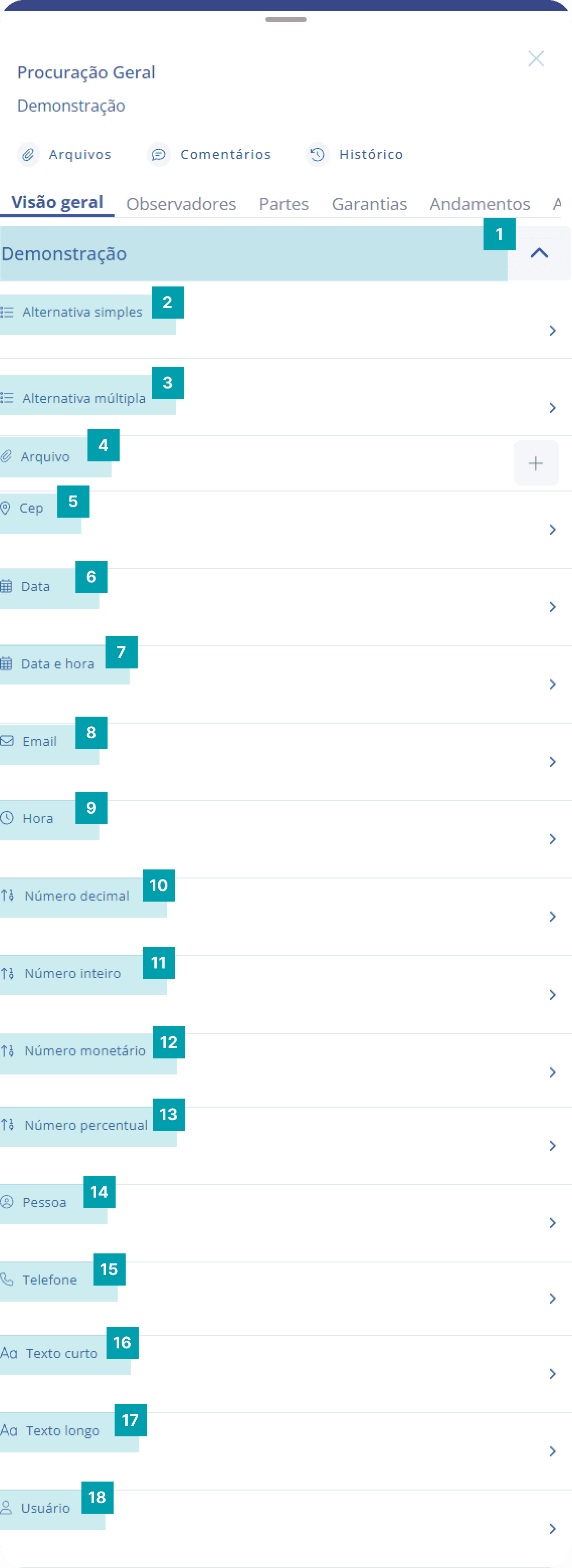
Dynamic field category – Shows the title of the dynamic fields section; it can be configured in the web platform. When clicked, you can expand or collapse the field view.
Single choice – Presents options; only one can be selected.
Multiple choice – Presents options; more than one can be selected if needed.
File – Uploads a file, allowing selection of a file from the device or taking a live photo. It accepts traditional file formats.
ZIP code – Presents the correct format and character limit for documenting a ZIP code.
Date – Shows the entered date in the format xx/xx/xxxx.
Date and Time – Allows entering a date, associated with a time for more precise information. The format is: xx/xx/xxxx xx:xx.
Email – Presents the ideal format for documenting an email address, including format validation to avoid errors when adding or editing the information.
Time – Shows the entered time in the format xx:xx.
Decimal number – Presents numbers with digits after the comma, ideal for entering fractional numbers.
Integer number – Presents only whole numbers, ideal for entering quantities.
Monetary number – Presents automatic punctuation (period or comma), ideal for declaring financial amounts.
Percentage number – Presents the percentage symbol, ideal for entering percentage values.
Person – Allows searching for and adding a person registered on the platform.
Phone – Presents a phone number format, allowing you to record tags, notes, and organize phone numbers accurately.
Short text – Allows adding a text with a small number of characters.
Long text – Allows adding a text with a large number of characters.
User – Allows searching for and adding a system user to the form.
Important note! The dynamic fields are customized with names chosen by the company that contracts the system, that is, a field of the “monetary number” type can be displayed in your unit as: “Budget Amount”, for example. They can also be separated by categories (item 1), that is, there will be more than one dynamic fields section to fill in. Despite the customization, knowing the types of fields that may be in your form is very important for the quality of your input or even to improve your form.
Observers panel
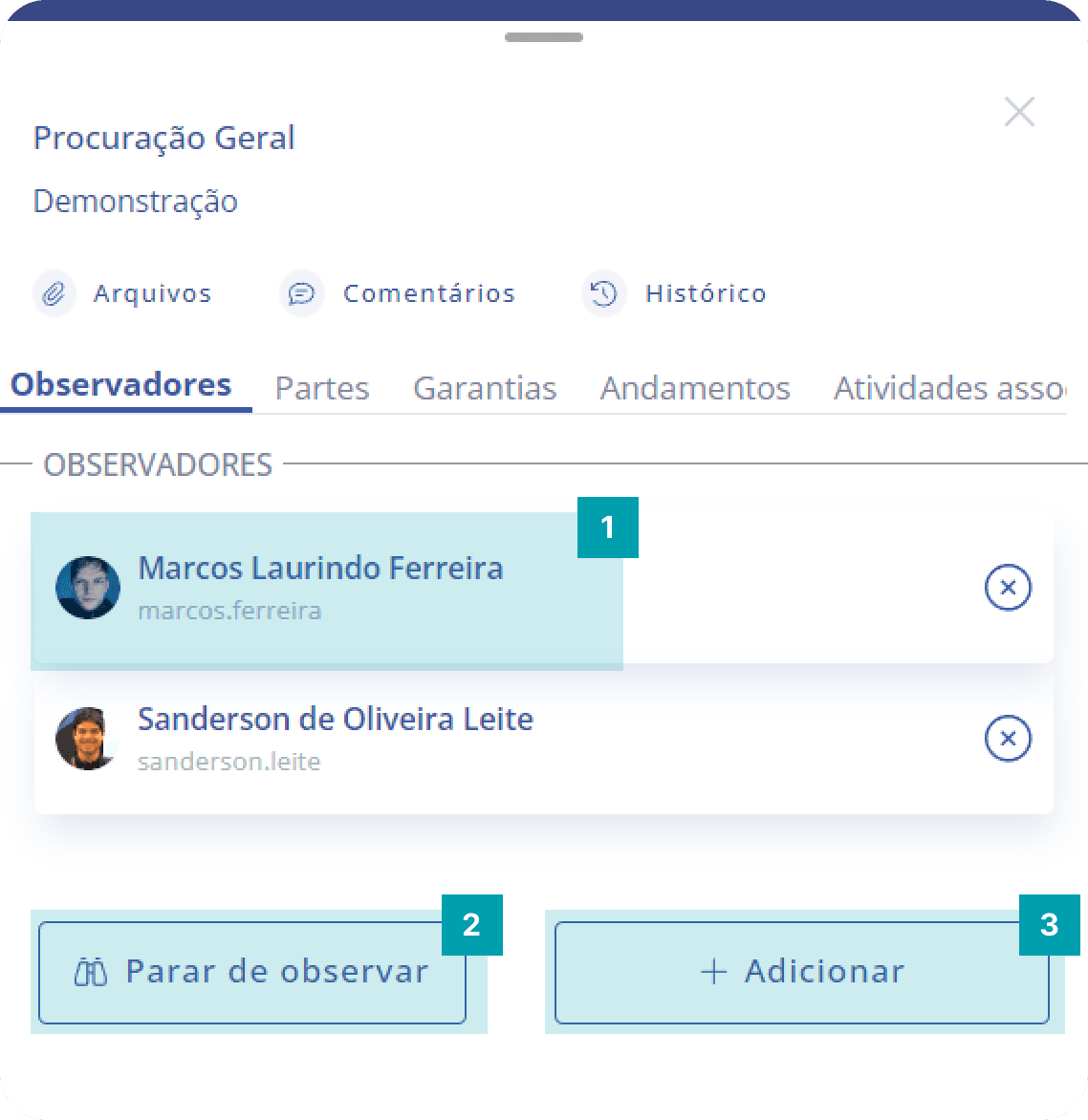
The observers panel is located just below the dynamic fields, and its main function is to show the users who are observing the legal document.
User – Displays a card for each observing user, containing: image (if any) + full name + username.
Observe – If you are not observing the legal document, this button is called Start observing; when clicked, you will start observing the document. If you are already observing, the button name changes to Stop observing; when clicked, you will stop being an observer of the document.
Add – When clicked, opens a modal to add users as observers of the document.
Parties panel
The parties panel is located just below the observers, and its main function is to show the parties that make up the legal document.
Position – Shows the name of the position in the unit that the user belongs to.
User – Shows the user who belongs to the position. If no user is defined for the position, the message displayed will be: No user defined.
To add parties to the legal document, follow these steps:
Add – Click the Add button to access the details modal.
Party type – Select the party type.
Person – Choose a person to associate.
Lawyer(s) – Choose one or more people for this field.
Description– Define a description that describes and makes it easier to understand the party.
Notes – Define relevant notes for the party.
Save – After completing all necessary fields, click the Save button to finish creating the party.
After completing the creation of the party, it will be displayed in the parties panel.
To remove a party, follow these steps:
Choose the party you want to remove and swipe the card to the left.
Delete – Click the red Delete at the end of the card to remove the party from the legal document.
Confirmation – After clicking the Delete button, a pop-up will be displayed to confirm your action.
Cancel – Click Cancel to cancel the removal action.
Remove – Click Remove to confirm the party removal.
Guarantees panel
The guarantees panel is located just below the parties, and its main function is to show the guarantees linked to the legal document.
Image – Displays the image of the associated person
Position – Shows the position in the unit that the person belongs to.
Name – Shows the name of the person who belongs to the position, using the social name if it is a natural person (PF) or the trade name if it is a legal entity (PJ).
To add guarantees to the legal document, follow these steps:
Add – Click the Add button to access the details modal.
Parties – Choose a party to make up the guarantee. Remember that it is necessary to have parties registered in the legal document.
Guarantee type – Choose a guarantee type.
Description– Define a description that describes and makes it easier to understand the guarantee.
Amount – Define an amount for the guarantee.
Expiration date – Enter an expiration date for the guarantee.
Issue date – Enter an issue date for the guarantee.
Notes – Define relevant notes for the guarantee.
Save – After completing all necessary fields, click the Save button to finish creating the guarantee.
After completing the creation of the guarantee, it will be displayed in the guarantees panel.
Progress panel
The progress panel is located just below the guarantees, and its main function is to show the progress items linked to the legal document.
Type – shows the type of legal document.
When clicking on a legal document type, a modal opens containing all legal documents of the selected type in which the unit is associated.
To add progress items to the legal document, follow these steps:
Add – Click the Add button to access the details modal.
Date – Enter a date for the progress item.
Progress type – Choose a progress type.
Description– Define a description that describes and makes it easier to understand the progress item.
File – Associate a file with the progress item.
Save – After completing all necessary fields, click the Save button to finish creating the guarantee.
After completing the creation of the progress item, it will be displayed in the progress panel.
Associated activities panel
The associated activities panel is located just below the progress items, and its main function is to show the activities associated with the legal document.
Add – Click the Add button to open the groupings modal.
Search – Click the search field and type the name of the grouping you want.
Selection – Select the desired grouping by clicking on its area.
Save – Click the Save button to finish your edit.
To disassociate an activity from the legal document, follow these steps:
Swipe – Swipe the activity card you want to disassociate to the left, and a red button with the text Disassociate will be displayed.
Disassociate – Click the red button named Disassociate to disassociate the activity from the legal document.
Confirmation – Message to confirm the disassociation of the selected activity.
Cancel – When clicked, you cancel the action of disassociating the activity.
Remove – When clicked, you confirm the disassociation of the activity.